Backyard concrete patio installation in Columbus
A concrete patio in Columbus, Ohio spends half the year hosting dinners and the other half under freeze and thaw. The mix, the base, and the joints decide whether it comes through winter in one piece, so that's where the attention goes.
Sedona Concrete pours patios across Columbus, Granville, and Licking County. Shape and size are up to you and the yard: squared off and simple, wrapped around a corner of the house, or big enough for a table at one end and a fire pit at the other.
What's included in a patio install
A patio job runs from layout through cleanup:
- Layout and grading, with slope planned so water runs away from the house
- Excavation and a compacted gravel base
- Forms for the shape you've picked, curves included
- Air-entrained concrete poured at 4 inches
- Control joints, plus isolation joints where the slab meets the house or steps
- Your choice of finish: broom, exposed aggregate, or stamped
Slab thickness, finishes, and joints
Patios go in at 4 inches, the same as driveways. They don't carry vehicles, but a thinner pour saves almost nothing and gives up strength, so 4 inches stays the standard.
Broom is the everyday finish: light texture, sure footing when wet. Exposed aggregate trades the smooth gray for visible stone. Stamped concrete takes patterns and color, and it's a big enough subject to have its own page: stamped and decorative concrete.
Control joints go in about every 8 to 10 feet so shrinkage cracks follow straight lines instead of wandering. Where the patio meets the house, a stoop, or concrete steps, an isolation joint separates the two pours so they can move independently without cracking each other.
Sizing the slab
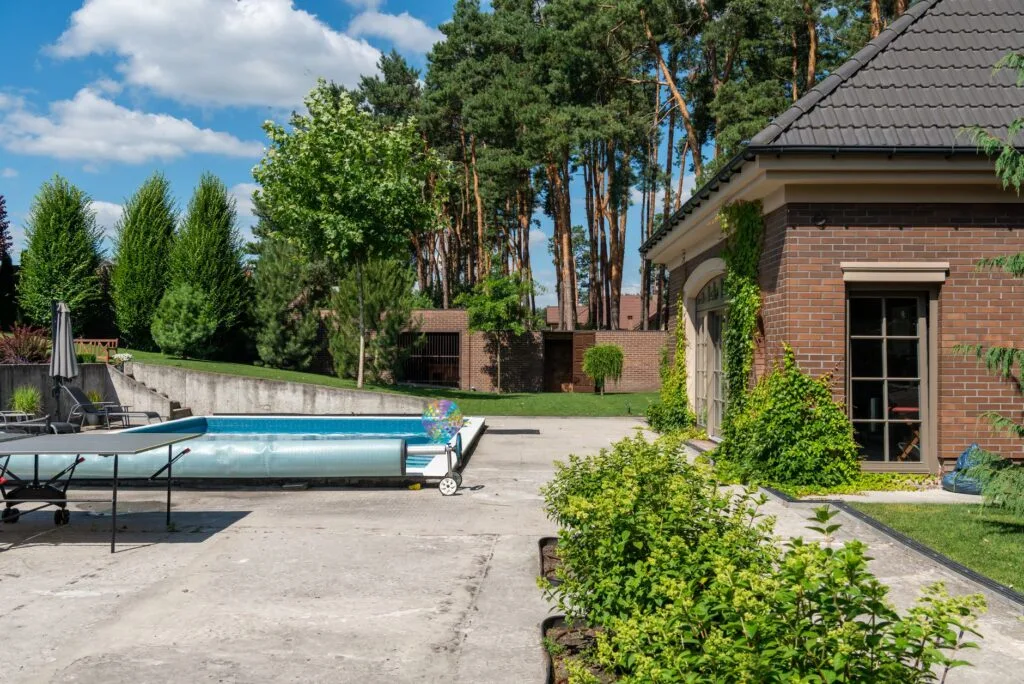
Sizing is worth ten minutes of thought before anything is formed. A dining set wants roughly 12 by 12 feet so chairs can pull out without leaving the concrete. Add a grill zone or a fire pit and 16 by 20 starts to feel right. Pouring a few extra feet now costs far less than cutting in an addition later.
Made for Ohio winters: why air-entrained mix matters
Water gets into the surface of every outdoor slab. When it freezes it expands about 9 percent, and that pressure flakes small chips off the surface. That's the scaling you see on old patios and city sidewalks, and Central Ohio's winters run enough freeze-thaw cycles to do it fast.
Air-entrained concrete is the defense. An admixture folds microscopic air bubbles into the mix, around 5 to 7 percent of its volume, and those voids give freezing water room to expand without breaking the paste around it. It's standard practice for exterior concrete in this climate and not a corner worth cutting.
One more winter habit: skip the deicing salt during a patio's first winter while the surface is still gaining strength. Sand gives traction without the chemical attack.