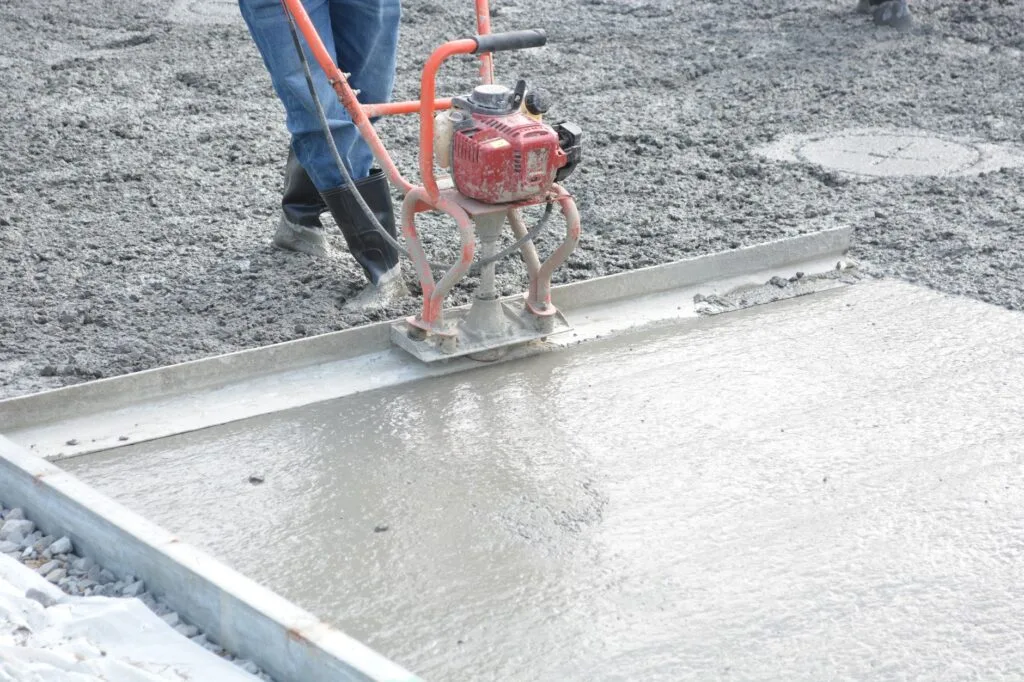

A concrete slab in Columbus, Ohio sits on clay soil that holds water, freezes hard in January, and moves a little every year. The finish troweling is the part you see, but the pour is decided lower down. Base compaction and reinforcement determine whether that floor is still flat years from now.
We pour garage floors for new builds and replacements, slabs for sheds and outbuildings, and pads for additions and mechanicals.
How thick should a garage slab be?
Four inches is the standard for a residential garage floor, and it handles cars and light trucks with room to spare. Heavier loads change the pour.
- Cars, SUVs, and light trucks: 4 inches
- Loaded work trucks, trailers, and RVs: 5 to 6 inches
- Vehicle lifts and other point loads: thickened pads under the posts
It's much cheaper to add an inch of concrete at pour time than to deal with an overloaded slab after the fact. If a lift or a heavier vehicle is anywhere in your plans, size the slab for it now.
Base prep and vapor barriers
What's under a slab decides how it ages. Topsoil comes out, gravel goes in, and the base gets compacted in lifts so it can't settle later. Skipping compaction is the classic shortcut, and it shows up two winters later as a cracked corner.
On garage floors, a plastic vapor barrier goes over the base before the pour. Central Ohio ground holds moisture most of the year, and without that sheet the slab pulls it up through the concrete. The result is a floor that sweats in humid weather and floor paint that won't stay stuck.
Mesh, fiber, or rebar
Concrete is strong when you press on it and weak when you pull on it, so slabs get reinforced. The right choice depends on the load.

Welded wire mesh is the usual pick for garage floors. It won't stop a crack from forming, but it holds both sides tight so a hairline stays a hairline. Fiber mixed into the concrete itself does similar work with no steel to place, which suits shed slabs and lighter-duty pads. Rebar is for real weight: thickened edges, lift pads, and anything an engineer has drawn. It's structural, where mesh and fiber are mostly crack control.
Floating vs monolithic shed slabs
A shed or detached garage slab gets poured one of two ways. A floating slab is a pad resting on its gravel base, free to ride seasonal ground movement. It's the simpler pour and fine for most sheds. A monolithic slab pours the floor and a thickened perimeter edge as one piece, so the building gets a footing and the edge stands up to frost better. Building size, what the walls carry, and local code usually settle which one you need.
Slope and drainage
A garage floor shouldn't be dead level. It gets pitched toward the door, typically around an eighth of an inch per foot, so snowmelt runs out instead of pooling under the car. The apron outside the door slopes away from the building. It's a small detail that decides whether you get a dry floor or a skating rink in February.
What drives garage slab cost for Columbus homes
Slab pricing comes down to a handful of drivers: square footage and thickness, whether an old slab has to be broken out and hauled off first, how much base work the ground needs, and how close a truck can get to the pour. Tear-out and poor access move a bid more than most people expect.
If the floor you have is cracked but still flat, concrete repair and resurfacing may be the cheaper route. It's worth pricing both.